Free Study Guides for Students — CAPE, CSEC and Caribbean history, written for Guyana.
Every guide on this page is free to download, free to print and free to share. Each one is written to the CXC syllabus in force — objective by objective — with real Caribbean studies and cases, past-paper-style questions with answer plans, and the exam strategy that turns knowledge into marks. No login, no forms, no charge.
CAPE study guides
Sixth-form guides for the Caribbean Advanced Proficiency Examination. Each one covers the whole Unit, walks the School-Based Assessment section by section, and includes a war room for the private candidate’s alternative paper.
CAPE Sociology, Unit 1
Sociological Concepts, Perspectives and Methods · Social Institutions: Family, Religion, Education · Social Stratification. Mapped to CXC A27/U2/13 objective by objective, with the Caribbean scholars the examiners name, essay questions with answer plans, Paper 01 drills, the SBA walked section by section, and a war room for Paper 03/2.
CAPE Sociology, Unit 2
Population and Development · Crime and Deviance · Caribbean Social Issues: Poverty, Health and Environment. The evidence Unit: every theory with its Caribbean case, every issue with its law and its date, the specimen questions worked, and the private candidate’s Paper 03/2 planned.
CAPE Law, Unit 1 — Public Law
Module 1 complete, mapped to CXC A23/U2/17: natural and positive law from Berbice 1763 to McEwan at the CCJ; the sources of Caribbean law; the courts from Petty Sessions to the Caribbean Court of Justice; judges, the AG and the DPP; the jury; ADR; the Ombudsman — and the private candidate’s Paper 032 war room.
CSEC and history study guides
For Forms 4 and 5 and for anyone reading the county’s history seriously.
Theatre Arts
A complete course for CSEC Theatre Arts: the history of the Caribbean stage with dates you can defend, the theory that earns marks, the practical craft you can drill, and the examination paper by paper — with a worked case study built from a Guyanese wake.
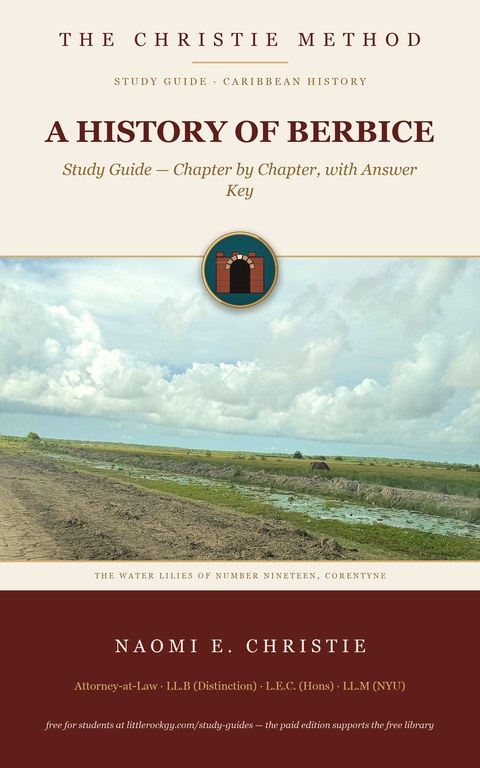
A History of Berbice — Study Guide
The companion to A History of Berbice for senior-secondary and first-year students: what each chapter argues, key points, terms, comprehension and discussion questions, a timeline, a glossary, whole-book essay questions and a full answer key. Nothing in it comes from outside the book.
How to use these guides
- Get the syllabus first. Every guide cites it by objective number so you can check the book against the document the examiner marks from. CXC syllabuses are free at cxc.org.
- Read a chapter whole, then take it apart. The Story, then the core content, then a worked exam answer, then the strategy box, then practice — every chapter walks the same five beats.
- Write under time. The answer plans at the back are bones, not model essays. Put the flesh on them yourself, with the clock running.
- Carry the current figure. Where a statistic changes yearly the guide tells you where the number lives. Quote it with its year and source.
Teachers and schools: print and photocopy freely for your students. If a guide helped you, tell the next student where to find it.
More guides are added as they are completed. Published by Little Rock Press · Little Rock Guyana · New Amsterdam, Berbice.